
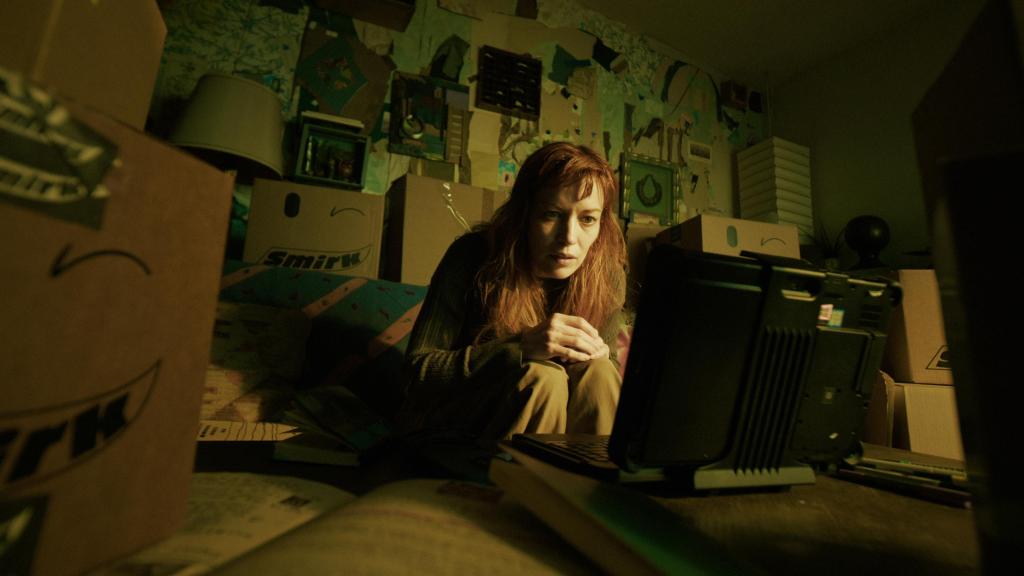
In an era where you can buy virtually everything online, it’s sometimes difficult to imagine the time before. But what if you start receiving packages that you certainly didn’t order? In huge amounts? The protagonist in Russell Goldman’s Sender is going through just that. A psychological drama starring Britt Lower in a lead role isn’t only a story about paranoia and how easy it is to manipulate someone, especially as technology rapidly advances. It’s also a complex character study and a story about alcoholism, consumerism and family dynamics.
Julia (Britt Lower) is having a tough time. She was recently fired for inebriation at a workplace. Now sober for three weeks, she attempts to rebuild her life in a new place to live, attending (or at least trying) AA meetings that she despises. In her spare time, Julia shops online for anything and everything at one of the e-commerce companies called Smirk (I must add: the entire logo/art design of Smirk is inventive). But suddenly, Julia begins to receive packages that she didn’t order — among them a corkscrew (which for an addict is like mocking), as well as protein powders, blender, and other household items she never ordered.
The incoming packages cause Julia to fall into a paranoid rabbit hole as she desperately tries to find who is responsible for this and find a person who can help, especially as the online retailer denies being responsible for the glitches. As more packages arrive, they become more and more personal and Julia starts feeling that someone is watching her. The only people she can share her concerns with are her overbearing sister Tatiana (Anna Baryshnikov), Charlie (David Dastmalchian) who’s a Smirk carrier, and Whitney (Rhea Seehorn), a reserved woman Julia met at one of the AA meetings.

Sender is a film that works on multiple different levels. At the forefront, we have Lower as Julia who slowly but surely descends into obsession and madness over un-ordered packages that keep showing up but that’s not all. As the blurry, shaky retrospective scenes play out meaning to portray her inebriation that caused the job loss, they blend with her new reality, where Julia tries so hard to remain sober while she chain-smokes and drinks cans upon cans of the Celsius drink. At the same time, as mentioned above, the packages almost seem to be mocking her, trying to break her to come back to her old habits.
The supporting cast is as important as the lead in creating the atmosphere of paranoia and dread. Seehorn, who’s currently a lead on Apple TV’s Pluribus by Vince Gilligan, is no stranger to portraying complex characters. And even though her character Whitney (or ‘Whiskey Whitney’ but don’t call her that to her face) isn’t there a whole lot, she still plays a vital part and will leave you utterly speechless in the culmination of Sender. Dastmalchian, too, is outstanding, portraying a soft-spoken, quirky carrier who wants to help Julia solve the case. And what’s better than the guy on the “inside”?

The direction and writing of the film is also impressive; Goldman does an excellent job, crafting that feeling of anxiety, dread, and obsession. It manifests through rapid-fire editing and brief, staccato scenes. In a way, it makes you a little bit mad as well, as you experience Julia going through her research and recording countless of voice messages to Whitney, detailing what she’s going through.
Pacing, too, is just right. Even when you might think you’re getting a bit lost in the past and presence, the creator makes sure you follow suit. It’s almost like threading on that thin line, like you’re going crazy alongside the main character. Every other component, whether it’s a soundtrack, set design, or costume design (Julia wears some great outfits I myself would certainly wear) contribute to the Sender being a film that one simply must see.
In a nutshell, Sender is a story about addition, recovery, paranoia, consumerism, how easy it is to make someone go crazy, especially with the rapidly advancing technology. It also gives us something else to ponder: how much power do these retail companies have? How much of our information and details about our personal lives they collect? And is it really worth it in the end to give them so much power just in the name of convenience?
Grade: A-




 The Film Nerdette
Leave a comment